Tuesday, 26 May 2020

Artificial Intelligence in Automobile Industry


According to Builtin, Artificial Intelligence can be defined as ,
Artificial intelligence (AI) is wide-ranging branch of computer science concerned with building smart machines capable of performing tasks that typically require human intelligence.
              From last few years Artificial Intelligence or AI became the hot topic and great career option for the many people.However, the idea of AI is not relatively new to the researchers,.There is no doubt that AI has the capability to impact our life. The question of in what level it will make an impact. And this is still in an imaginary scenario for the normal people.However, the researchers and subject matter experts can & has predicted the impact that AI will make in future. In 2018, AI expert Dr.Kai-FU Lee said that, "AI is going to change the world more than anything in the history of mankind.More than electricity."
           
            World's well known giant companies have started utilising and developing the products using AI.For example, Amazon came up with a AI based virtual assistant known as Alexa. With the combination of Sensors,cameras,Radar and Artificial Intelligence Tesla is working to develop the driverless cars,etc.

               In this article ,we will discuss in brief about the potential impact AI can make in Automotive industry. So,lets start.

# Engineering Design -

            Long back,Computer Aided Design (CAD) brought the revolutionary change in the way of creation,modification, analysis and optimization done in the designs. CAD helped to reduce the amount of time spent on manual design and drafting resulting into increased productivity,quality of design,ease of storage and document of the design records. Even though these technology greatly reduced labour work of human but its still dependent on human to create design and drafting work.
           With AI, I believe it possible to reduce more than 50 % of human intervetion in design and drafting of particular products.To understand, we will take an example of splined solid half shaft which is used in automobile differential for providing power to vehicle wheels. For CAD model, designer need to create a solid round shaft of particular length and then he will extrude the material for spline tooth creation. Suppose, with no calculations involved, designer takes appro.2 hr of time to design. Instead, with AI, we can create the CAD model of the same shaft in less than 15 minute just by entering required dimensional values like length of the shaft, diameter, spline and material details. AI will automatically generate a CAD model based on provided inputs.
            Various CAD software developers working on integration of AI in CAD softwares. In next 5-10 years, it is not surprise to see and use such a solutions in engineering design and drafting.

# Procurement -

            Procurement is an most critical and more focused function of any organisation.With  error free procurement, organisation can run its business more smoothly and can make more profits too.Artificial Intelligence already transforming procurement. With automating large time consuming processes, AI has the potential to rapidly change the procurement practices used around the world.Currently, it will be too early to say that all the procurement activities will be done by AI,because procurement is an complex,involves analytics and decision making. However, AI can be used in some lengthy and time consuming procurement activities like Spend Analysis, Vendor Search from large data,collecting market data,etc.
According to Sievo.com,below are the 7 common procurement areas where AI can be used.

Procurement AI Software

7 common areas for AI in Procurement


Saturday, 2 May 2020

Lithium Ion Battery - Working ,Classification & Battery Cycle | Words of Engineer

If you are able to read this post on the go,on the portable devices like mobile phones or Ipads, you must say thanks to the "Lithium Ion Battery"(Li-ion ) and their developers,who worked over the years to made this happen.

Wondering,why you must say thanks to them ? Read the full article to discover the answer.

• What is Battery ? And its classification.
• Why lithium is used in batteries?
• Working of Lithium Ion Battery.
• Battery Cycle

What is Battery ?

Battery is an device which converts chemical energy directly into electric energy, which can provide power to electric portable devices like mobile phones, flashlights and even for Electric vehicles too.Fossil fuels like coal,oil,gas are currently primary energy sources and they fueled  industrial revolution and global economic growth. However,due to its finite storage, harmful effects on climate,and increased global warming made world to search for the alternative or clean fuels.

Batteries can be classified into two types based on its "re-usability".

1. Primary Battery ( Non- Rechargeable /Single use)

2. Secondary Battery (Rechargeable )

Primary batteries are designed for the use until its energy exhausted and then it is disposed.There chemical reactions can not be reversible,so they are not rechargeable. On other hand, secondary batteries chemical reactions can be reversed,which makes them rechargeable.But, because of the internal corrosion and loss of electrolyte secondary batteries can be recharged at definite battery cycles only.

Why Lithium is used in batteries ?

Following are the main reasons of using Lithium in batteries.

Highly reactive

Lithium is highly reactive because it readily loses its outermost electron, making it easy to get current flowing through a battery.

Lighter in weight

Lithium is lighter in weight than Lead,which is needed for portable devices.

Higher Energy Density

Lithium has energy density higher almost twice than nickel cadmium. Energy density is the amount of energy in given mass.

Low self discharge

Compared to nickel cadmium,lithium has self discharge less than half.

How Li-ion battery works ?

Li-ion batteries consist of Anode, Cathode ,Separator, Electrolyte & two current collectors( Positive & Negative). Both the Anode & Cathode has the capability to store the Lithium ions.
Electrolyte is used to carry Lithium ions from anode to cathode & vice versa through separator.Below image shows the working of Li-ion battery.

Flow of Lithium Ions -

        State                                        From                                To

   While Charging              -            Cathode         =>         Anode
   While  Discharging        -            Anode            =>         Cathode

Working of Lithium Ion Battery


Battery Cycle

According to the Apple, Apple Li-ions batteries work in battery cycles. One charge cycle is completed when you have discharged 100 % of your battery capacity but not necessarily all from one charge. For example, suppose you have used 75% of your battery capacity one day & charged again to 100% battery capacity.On next day, you have used 25% means you have discharged total 100 % of battery capacity in 2 days & this is considered as one complete battery cycle.


One Cycle
Charges
+100%
Discharges
-75%
+75%
-25%
+25%

One charge cycle is completed after you’ve discharged 100% of your battery’s capacity.


Common Facts about Li-ion Batteries -

1. First commercial Lithium Ion battery was made by Sony corporation in 1991.
2. For safety reasons,while travelling by flights,spare or uninstalled lithium metal or lithium-ion batteries are must be removed from check in baggage and should kept with passenger in carry on baggage.

For more engineering related posts, keep visiting 'Words of Engineer'

Monday, 13 April 2020

Homologation & Certificate of Conformity (CoC) definition and meaning | Words of Engineer


Meaning of Homologation and Certificate of Conformity (CoC) :

Homologation & CoC is mandatory for all type of vehicles that are made or imported into country.
But before directly jumping on 'Homologation', we need to understand the term 'Roadworthiness'.

Roadworthiness -

Roadworthiness is ability of vehicle to be in a suitable operating condition or meeting acceptable standards for safe driving and transport of people or goods in roads.The roadworthy inspection is designed to check the vehicle to make sure that it's important auto parts are in a good (not top) condition that is enough for safe road use.

 It includes:-
  • Wheels and tyres
  • Steering, suspensions and braking systems
  • Seats and seatbelts
  • Lights and reflectors
  • Windscreen, and windows including front wipers and washers
  • Vehicle structure
  • Other safety related items on the body, chassis or engine
Homologation -

Homologation is the process of certifying that particular vehicle is roadworthy and matches certain specified criteria laid out by government for all the vehicles which are made and imported into that country. Test ensures that vehicle matches the requirements in terms of emission, safety & road-worthiness.

In India - Homologation is categorized as below -

Category L 1 - Motorcycle with maximum speed not exceeding 45 km/h and engine capacity not exceeding 50cc if fitted with thermic engine or motor power not exceeding 0.5 kilo watt if fitted with electric motor.
Category L 2 - Motorcycles other than category L1


Category M 1 - Motor Vehicle used for carrying passengers, comprising not more than 8 seats including driver
Category M 2 - Motor Vehicle used for carrying passengers, comprising seats 9 or more than 9 but gross vehicle  weight less than 5 ton
Category M 3 - Motor Vehicle used for carrying passengers, comprising seats 9 or more than 9 but gross vehicle  weight more than 5 ton


Category N 1 - Motor Vehicle used for carrying goods,& having gross vehicle weight not exceeding 3.5 ton
Category N 2 - Motor Vehicle used for carrying goods,& having gross vehicle weight exceeding 3.5 ton but not exceeding 12 tons
Category N 3 - Motor Vehicle used for carrying goods,& having gross vehicle weight exceeding 12 tons

Certificate of Conformity or CoC -

A Certificate of Conformity or CoC is a mandatory document which is necessary for Customs clearance of exports to many countries around the globe.The Certificate of Conformity shows that the goods being exported comply with the relevant technical as well safety regulations and national, regional or international standards of the country of import.

Who issues CoC ?

Certificate of Conformity or CoC can be issued by manufacturer itself or independent third party labs after all the required test passed.Below are the few independent test facilities in India.

Homologation Test Facilities in India -
  • ARAI-Pune : One of the premier testing facilities of the country which carries out more than 90 % of India's homologation activities presently.
  • iCAT Manesar : International Center for Automotive Technology ( iCAT) Manesar,is the principal homologation & R&D center in North India.
  • GARC Chennai : The center have certification test facilities to conduct the performance testing of full range of automobile.The center have the center of excellence for passive safety,EMC and automotive infotronics.
  • NATRAX Indore
  • NIAIMT Silchar
  • VRDE Ahmednagar


# References -


Sunday, 1 December 2019

What is Bill of Materials ? Why it is used & Types of Bill of Materials | Words of Engineer


What is Bill of Materials (BoM)?

Bill of material abbreviated as BoM can be defined as ‘collective list of all the material required for the building final product, which includes semi-finished, finished parts along with their quantity, unit of measure.’

Why it is used?

1.   Product define & costing –

On Production lines, it is not always possible to build the final product by referring the drawings. Due to variations in individual’s ability to interpret drawings & difficulty in finding parts position in final product drawing print can create delays in production of final products. So, to tackle this, final product is divided into sub-assemblies & all the part required to build the particular sub-assemblies are grouped together for ease of assembly process. This also makes product costing process easy & quick.

2.  Material Requirement Planning (MRP)

MRP is a technique integrated in ERP software which enable material planners to generate the material requirement of rough, semi-finish, finish  parts are needed for the final products with actual material required date, their lead time, responsible buyer & supplier details.

BOM Structure -

BoM structure is a breakdown of final product from higher level sub-assembly to low level component. Each sub-branch of final product labelled as ‘Level’ starting from 0 (Zero) assigned to final product & so on. These levels can be extended until single part found on product structure.


BoM Types –

1. Technical Types

 ·         Alternative/ Multiple BoM –

When same final products are built with different BoM parts known as ‘Multiple/Alternative BoM’ of that product. For example- Redmi Note 7s phone comes with 3 colour options, specifications of 3 options are same except colour. So, BoM of Redmi Note 7 has 3 alternative BoMs & as per the demand production select the alternative BoM in system

·         Variant BoM –

When different final products are built with common BoM parts are known as ‘Variant BoM.’ For example- It might possible that company may produce another mobile model using existing Note 7s BOM parts.

2. Usage Types – According to BoM usage requirement different departments maintains respective BoMs in system.
·         Engineering BoM
·         Manufacturing BoM
·         Sales BoM
·         Costing BoM


Saturday, 5 October 2019

Portal Drop Axle | Words of Engineer


Portal  Drop Axle

Generally, vehicles can be classified into two groups based on its application area-

1. On-Highway Vehicles

2. Off-Highway Vehicles

Simple explanation of difference between On Highway and Off Highway vehicles is, On highway vehicles are used on normal terrain and Off Highway vehicles are used in rough terrains like rocky, mud, agriculture land,mining and construction sites,etc.

The concept of power transfer from engine to wheel is same in both vehicle types and done via Engine, Gearbox, Driveshaft, Axle and finally to wheel.Definitely, specifications of those drivetrain components may vary depending on the requirements of On Highway and Off Highway vehicles.Gear Reduction,ground clearance,speed are the few examples of requirements.

From drivetrain components,axle is the only component which is directly in contact with wheels and used to transfer power to wheels. There are different types of arrangement between Axle and wheels are available for On Highway and Off highway vehicles.

In On highway vehicles, Axle tube centerline and Wheel centerline is mostly same,i.e.No offset between them.

Layout of On highway vehicle axle explained.
Normal Axle Layout


Whereas,in Off Highway vehicles, sometimes,there is offset (usually above ) in axle tube centerline and Wheel centerline.This distance between the two centerlines is called as "Drop Distance" and measured in mm.


Off Highway vehicles Portal Drop Axle explained
Portal Drop Axle 

Along with the drop distance,these Drop axles has simple gearbox installed at both wheel ends which is used as gear reduction. So, these axles are also called as "Two Stage Reduction axles".
First reduction occurs in differential by Ring & Pinion drive gear and second reduction is done at wheel end by simple gearboxes.

Portal Drop Axle Graphics
( Image Source - Pinterest
Image Credit - Respective owners )

There are various advantages of Portal Drop Axles, which made Off Highway vehicles to adopt this design,and are mentioned below -

Advantages of Portal Drop Axles -

1. Two Stage Reduction

Due the addition of gear reduction at wheel end, torque reduction strain on other drivetrain components can be lowered,which provides room for design of  smaller size Ring and pinion gears, differential case for same gear reduction.

2. Ground Clearance

As compared to normal layout, Portal axles provides higher ground clearance to the vehicles as size of differential is reduced,axle tube and differential case are mounted above the wheel centerline.

Disadvantages of Portal Drop Axles -

1. Slightly Increased maintenance cost.

Due to increase in number of gears in axle, oil needed for the lubrication is increased, which also needs periodic check of oil at every 8000-10000 km.

2. Not easy for installation

Portal Drop Axles are not easy to install, expertise is needed for correct installation to avoid potential safety and cost issues.


That's about " Portal Drop Axle" from Words of Enginner.


Thursday, 26 September 2019

What is "Benchmarking" ? Concept ,Types and Procedure of Benchmarking | Words of Engineer


What is Benchmarking ?

Whose straight drive is absolute bliss to watch in cricket?

"Sachin Tendulkar "

Who's capable of bowling back to back yorker and make batsman's play as hell ?

"Lasith Malinga"

Why you immediately named these two players only ?

It's because they created a "Benchmark" for others with their work. So,after them,any player you see good at above skills will directly compared with "Benchmark Setters".

That's Benchmarking at glance.

Seems interesting ? So, let's dig deeper to understand benchmarking in engineering.


What is Benchmarking ?

Below quote from Author, Philanthropist Mr.Tony Robbins about success which can be bluntly relatable with benchmarking.

" If you want to be successful,find the someone who has achieved the results you want and copy what they do and you will achieve the same result".

formal definition of benchmarking can be written as -

" Benchmarking is a business tool used for identification, recognition, and adaption of best practices which have shown superior results in similar businesses".

Why to do Benchmarking ?

Benchmarking is simply essential,

1. To improve efficiency by continuous improvement in performance and processes.

2. To take extra edge on competitors while dealing with customers.

3.To outperform within your industry.


Types of Benchmarking -

Broadly, Benchmarking can be classified in three types - 

Strategy Benchmarking

This type of benchmarking is used by management to evaluate organization's strategic moves with respect to other businesses. Company growth - survival strategies, competencies, innovation levels are the few factors of strategic benchmarking.


Performance Benchmarking

This type is used to evaluate the organization's performance by its products or services. Cost ,sells,profit -loss,growth rate are  examples of performance benchmarking factors.


Process Benchmarking

Process Benchmarking is done to find and adopt best practices of specific business process. Purchasing process,Industrial safety processes etc.are the example of process benchmarking.


How to do Benchmarking ?

Benchmarking is a simple "OPDCA - Observe,Plan,Do,Check,Act".
cycle. Just by answering the following questions and steps, you can easily complete the benchmarking process.


Planning

What - to Benchmark
When -Decide timeline for benchmarking
Who  - Select a team for benchmarking
Whom - find the competitor
How  - Decide key measures for evaluation

Analysis

Collect - competitors data
Compare - with your existing processes
Coincide - decide targets for improvement because of cost associated with it or lack of technical expertise or say any other factors all improvement points can not be feasible to implement.

Action

Inform - Benchmark study result to management and get approval for implementation
Improvement - Divide improvement plan in short, medium,long term with timelines.
Implement -   Plan as decided

Review

Review - Implementation results
Report - Implementation effectiveness
Repeat - The Benchmarking Process

So,that's about Benchmarking,its needs,types, and process to do benchmarking.

Did I missed any point on Benchmarking or you have any questions on Benchmarking ? Comment below and let me know.

Saturday, 21 September 2019

Classification of Electric Vehicles | Words of Engineer


Classification of Electric Vehicles -


Hey guys, in previous article 'Key components of electric vehicles' we have seen key components and it's functions.Demand of EVs are gradually increasing along with increase in customer requirements. Requirements like ,some customer may want to drive fully electric vehicle on other hand some may want hybrid.So, to fulfil this requirement arrangements of key components are required however their function remains the same. Let's get into the classification of Electric Vehicles.

Electric vehicles can be classified on the basis of -

# Degree of Electric energy as main source

1. Pure Electric Vehicle

Pure Electric Vehicles, are the vehicles in which only battery or fuel cell is used
to drive electric motor which finally rotates the vehicle wheels and helps to propelled on ground. Further,pure electric vehicles can be classified as Battery Electric Vehicles and Fuel Cell Electric Vehicles.

1.1 Battery Electric Vehicle ( BEV)

As name states, electric vehicle runs only on battery. Battery Electric Vehicles uses chemical energy stored in rechargeable battery packs. BEV doesn't have IC engine instead they have Electric motors for propulsion.

1.2 Fuel Cell Electric Vehicle ( FCEV)

Fuel cell electric vehicles can be called as electrochemical engine which uses hydrogen and oxygen from air as fuel. FCEV has battery,hydrogen tanks,fuel cell stack,booster, electric motor and power control unit and interesting part is it emits only water.

Here attached an article from Toyota Europe which explains fuel cell working  in various road conditions.
      
 2. Hybrid Electric Vehicle (HEV)

Hybrid electric vehicles uses two power source namely battery and IC engines.
HEV uses electric motor for start off and switches to IC engines as load increases. Battery used in HEV are internally charged by IC engines and regenerative energy received in braking action.

2.1 Plug-in Hybrid Electric Vehicle (PHEV)

PHEV is an exception of standard HEV,which can be charged externally too means it can be charged by on board engine, regenerative energy and by external source.

# Power Configuration

     1. Series Configuration    

In Series Configuration ,all the Electric Vehicle components are arranged in series i.e in a line starting from IC engine, Generator, battery, Inverter, Electric Motor and differential. IC engine provides power to battery only and battery stores this received power passes to electric motor. There is no connection between IC engine and final wheel drive elements.

     2. Parallel Configuration

In Parallel Configuration, IC engine and Electric motors are arranged parallel to each other. Vehicle can receive it's tractive power from IC engine or electric motor or from both simultaneously.

Arrangement and Power flow in Parallel Configuration of Electric Vehicles


Additionally , I found another necessary  EV classification on EVgo.com based on how fast batteries can be recharged.

# Battery recharge speed

1. Level 1

Level 1 charging uses standard household 120V electric outlet for charging and it can take approximately 7-8 hrs for full charging of battery ranged for 70-80 miles.

2. Level 2

Level 2 charging uses special charging station places at public or workplace charging stations which uses 240V outlet to charge a battery in a approximately 4-5 hrs ranged for 75-80 mile.

3. Level 3

Level 3 charging are the fastest charging available currently solution which can charge a battery for a range of 90 miles in approximately 30 mins.

So, that about classification of electric vehicles from 'Words of Engineer'.

Thursday, 19 September 2019

Key components of Electric Vehicles | Words of Engineer


Key components of Electric Vehicles -

When we change from traditional system to any new system ,it is necessary to learn about the key components of new system because new system is basically combination of all the key components and systems efficiency depends upon the effective functioning of key components.

Note - Components mentioned below are only required components for 'All electric vehicles' where electric motor is the only power source for vehicle propulsion. And for hybrid electric vehicles apart from below components traditional vehicle drivetrain components are there such as IC engine.

Key components of Electric Vehicles -

1. Battery Pack
2. Electric Motor
3. Power Election Control
      - Rectifier
      - DC/DC Converter
      - Inverter

To explain the general overview of above components below block layout is created which shows the rear wheel drive axle with all electric drive means vehicle propulsion is powered by battery ,no IC engine used.

(This layout is for illustration purpose only,actual electric vehicle drivetrain layout may vary.)

Key component of Electric Vehicle are arranged in series configuration


Explanation -

Electricity we get at home from electric power grid is in alternating current (AC) form but battery stores energy
in direct current form .So, to facilitate the conversion of AC to DC, rectifier is used.

Battery is used to store energy. There are various types of batteries are used in electric vehicle.Lithium-ion batteries are commonly used in electric vehicles.
Maximum distance an electric vehicle can travel after fully charged is depends upon the battery size.That's why electric vehicle battery cost are higher. 
Inverter receives direct current from battery and converts to alternating current because electric motors runs on alternating current. 

Commonly used electric motors in electric vehicles are induction motors. In induction motor, alternating current is passed through the stator which rotates the rotor.Speed of rotor can be adjusted by varying frequency of alternating current passing through the stator.

DC/DC Converter are used to reduce the voltage to 12V for auxiliary battery which is used for starting, lighting and ignition (SLI).

Electric motor is coupled to differential which is used for torque slit and helps vehicle to propell on ground.

Above are the key components of electric vehicles and overview of their function.

Monday, 16 September 2019

Why Electric Vehicles are needed ? It's major reasons | Words of Engineer


Why Electric Vehicles are needed ?

Recently you may have heard the news of major automobile manufacturers announced plan for launching their electric vehicles for Indian market. Few manufacturers are already launched their EVs like Hyundai Kona Electric, Tata Tiago, etc. And the news of cab rental company Ola also has planning for electric vehicles gained more attention. There can be a possibility of most citizens having the question Why electric vehicles? and that can't be denied. So, Let's dig deeper to understand why electric vehicles are needed now?

Basically, Electric Vehicles (EV) are the vehicles which runs partially or completely on electric motors rather than conventional propulsion methods such as internal combustion. Electric vehicles include electric cars, electric trucks, electric motorcycle-scooters, electric bicycles etc.

Major reasons “Why Electric Vehicles are needed ?”

1.       Environment - Global warming

According to an ongoing temperature analysis conducted by scientists at NASA’s Goddard Institute for Space Studies (GISS), the average global temperature on Earth has increased by about 0.8° Celsius (1.4° Fahrenheit) since 1880. Two-thirds of the warming has occurred since 1975, at a rate of roughly 0.15-0.20°C per decade. Global temperature mainly depends on how much energy the planet receives from the Sun and how much it radiates back into space—quantities that change very little. The amount of energy radiated by the Earth depends significantly on the chemical composition of the atmosphere, particularly the amount of heat-trapping greenhouse gases. A one-degree global change is significant because it takes a vast amount of heat to warm all the oceans, atmosphere, and land by that much.

To combat climate change, all the nations are agreed to take ambitious efforts by being a part of The Paris Agreement. According to the United Nations Climate Change, the Paris Agreement central aim is to strengthen the global response to the threat of climate change by keeping a global temperature rise this century well below 2 degrees Celsius above pre-industrial levels and to pursue efforts to limit the temperature increase even further to 1.5 degrees Celsius. Paris agreement requires all the nations to put their best efforts through Nationally Determined Contributions (NDC) also need to report regularly on their emissions and on their implementation efforts.

An independent scientific analysis, Climate Action Tracker (CAT) rated India’ 2030 NDC as “2° compatible”. The “2°C compatible” rating indicates that India’s climate commitment in 2030 is within the range of what is considered as a fair share of global effort but is not consistent with the Paris Agreement.

2.       Energy Security

Availability of energy resources on the earth are limited and that too unevenly distributed among the countries leading to high energy resources vulnerabilities. For the effective functioning of modern economies, availabilities of cheap energy are essential. International energy exchange programs helped to achieve globalization of the world.

“A country’s ability to secure energy for current and future demand and supply at uninterrupted rate at cheap price can be known as Energy security.

According to the International Energy Agency, energy security defined as “the uninterrupted availability of energy sources at an affordable price”.

All nations are working to find a way to meet energy security, and best effective solution will be creating an alternate energy resources such as electric vehicle adaption can turn into better solution for conventional fuels used for propulsion.

These are the major reasons of adaption of  Electric Vehicles . Let me know, if you have other reason to be considered as major by commenting below.

Saturday, 14 September 2019

Detailed Engineering Design Workflow | Words of Engineer


Detailed Engineering Design Workflow -

Regardless of time, when you enter in engineering field,you will definitely here the word "Workflow" and will experience the special attention,care taken by the higher management on this.So,before experiencing the same,why not to take a look at it now ?

What is Workflow ?

Workflow is the systematic division of process, in which process is divided into sequence of activities that necessary to perform to fulfil certain task. In workflow,work is being initiated,completed, acknowledged and passed to next activity.

Eg. Below is the sequence of activities needed to publish a blog post.

Writing a draft -- Proofreading -- Prepare a final -- Publish a post - Share with people.

Why workflows are needed ?

Workflows are necessary to automate repeated business processes with the aim to minimize errors and delays in completion of activity.Aditionally below are the few important points which can satisfy the question.

Workflows are needed to -

• Get clear overview of Business Process
• Identify unwanted activities involved
• Remove unwanted activities which reduces process time
• Helps in tracking project status
• Make people accountable for actions
• improve quality of customer service

Engineering Design Workflow -

To start any new product design and development it is necessary to reply  customer's request for quotation with our quote (Price,terms and conditions,etc) and get approval from customer ,then proceed for design.An initial bill of materials is needed for qoute costing. So,we can say that Bill of material is the first step of engineering design workflow. However, some organisation prefers to create final bill of material first then drawings on other hand some prefers to create drawing first then final bill of material. In both cases,initially either final or rough Bill of materials is created to complete qoute costing.

Here we will be discussing on process in which Bill of materials is created first then drawing are prepared.So,let's go into details.


Detailed engineering design workflow explaining from request for quotation to production release.

Explaination -

First step is business development team or sales team receives"Request for Quotation" along with technical requirements from the customer. Then technical specifications are transferred to application engineer to verify compatibility of own product being used for customer intended application. Once application analysis is done and application engineer is confident that organisation's product can fullfil customer requirements then it is passed to Bill of materials team where this team creates a list of parts which are required to build the product that requested by customer.  After this, bill of material is shared with the responsible plant costing engineer for cost estimation. Finally, qoute is prepared and submitted to customer. Once the customer approves the quote, engineering design process is initiated.

Monday, 19 August 2019

How Engineering Change Management works ? ECM Process | Words of Engineer


Engineering Change Management (ECM)

Have you ever gone for football match with basketball?  This could happen, if proper change communication of sport event is not done to all the team members. Similarly, in Automotive or any industry, changes in products in terms of design, manufacturing process or any other reason are needed to cope with varying customer requirements. And those changes need to be properly reviewed and approved by authorized personnel to avoid unwanted changes in products. Finally, those changes should be communicated to organisation’s respective personnel for the effective implementation in products. So, to facilitate the smooth & correct flow of change communication most of the organisation prefers Engineering Change Management (ECM).

It doesn’t matter, how small or big the change is, all changes done on product throughout the product life need to be requested*, analysed, approved, implemented & recorded in proper format. Changes in product could be anything like change in material, change in design, change in manufacturing process. For the changes which could affect fit, form and function of the product, a formal change notification needs to send and get approved by customer.

*requested means change requested from either internal or external customer, sometime working on product/design improvement this can be considered.

Engineering Change Management (ECM) Process –

Almost all organisations has similar ECM process which consists of change request, analyse, approval and implementation with variation in change request and approval methods. Below is the simplified flow diagram of ECM process -


Workflow of Engineering Change Management, ECR, EWO


1. Engineering Change Request

If any requester identify the change,after his primary analysis identified change is converted to change request. This engineering change request then forwarded to authorized product owners,who are responsible for product changes.

Anyone from organisation can raise a change request for any part or product however authorized approval personnel remains same.


2. Engineering Change Order 

After engineering change request is approved by authorized personnel. It is forwarded to engineering department for change analysis, feasibility check.  To
study in detail, whether this change is possible or not.

If change is possible,then engineering team create, update drawings accordingly.

3. Change Implementation

Once drawing are updated, manufacturing engineer create or modify process documents accordingly. Also ensures change is being implemented in product from decided production dates .

4. Engineering Change Release Note

After all ECO changes are implemented,production cut-off numbers are communicated to all required stakeholders of the organisation by manufacturing engineer via engineering change release note.

Thursday, 8 August 2019

Product Design Development In 5 Stage Gates | Words of Engineer


Product Design Development In 5 Stage Gates

In Product Lifecycle (PLC), we understood about the different life phases of product which are namely Pre-Introduction, Introduction, Growth, Maturity, Decline and Extended Growth. Success of any product lies in its successful design and development. As you may aware, design development of any product involves plenty of engineers from almost all departments of organization to work on it. This make design development huge and complex process. Question may arise here that, do we have solution for this? Answer is ‘Yes, we have solution, by systematic division, monitoring and tracking of work any major task can be accomplished. Considering this, many organisations have adapted ‘Stage Gate Process’. 

Stage gate is the project management technique in which project/program is divided in different stages with management decision review/approval points called as gates. Over the years, there are many concepts of stage gate process are developed by the experts, but traditional process is ‘5 Stage gate process’. 

In this 5 Stage gate process, total project (from Customer RFQ to Production release) is divided into 5 stages with 5 approval gates, those are mentioned below –


Stage-0                 Discovery
Stage-1                 Scoping
Stage-2                 Build Business Case
Stage-3                 Development
Stage-4                 Testing & Validation
Stage-5                 Launch

 Stage Gate Process


      Further this individual stages has many tasks under it which needs to be completed by different departments on schedule timelines. Above mentioned is the traditional 5 stage gate process, however every organisation has their own terminologies for each stage gate.So, that's about 5 Stage Gates process.


Tuesday, 6 August 2019

Business Screening Document | Words of Engineer


Business Screening Document -

Every company has their defined organisation management structure and this management team is responsible for creating a strong relationships with employees, shareholders and the customer.
Introduce and embrace fundamental and new company values among them.
Predicting the future market, guiding the company for its products to sustain in the market .Also increase company market growth in terms profit and reputation and so on responsibilities.

What is Business Screening Document (BSD) ?
When any company receives Request for quotation for the business opportunity from any other company or person.Before sending quotation to customer, receival company's Business development team has to present the opportunity in front of the company management team.So that management team can share their views on the opportunity and provide decision to proceed for this business or not.

What information this document has ?
To keep uniformity in Business Screening , company create a standard document which will be used for all the Business Screenings.
This document consists of below points -
1. Customer
2. Relation with customer
Management needs previous relation history of customer with the company in terms of engineering, quality,sales, purchasing, payment.
3. Customer Product details
In this section, overall information of final customer product is given like market need of product, features of the product, competitors having similar products,expected sales volume.
4. Sales region
 Not every product is suitable for all the region's of world.For example- Supercar can not be used in off highway roads. So,sales region and customers and company's presence in that region is an important factor.
5. Customer's Program timeline
Sometimes customer wants to launch product in market too quickly.It is important to know timelines,so that company's engineering and plant capabilities can be adjusted accordingly.
6. Annual Sales volume
Annual sales volume are need to plant capabilities and manpower management also for calculating expected overall company sales volume for the year.
7. Purchasing Terms
Purchasing terms explains,what type of purchase customer wants, one time purchase agreement or the agreement with timely scheduled.
8.Packing and shipment terms
What of packing and ways of shipment is expected from customer is explained in this section.
9.Payment terms
Payment Terms are mutually agreed by both the companies and varies from customers to customers. Sometime payment made on credit base or debit base depending upon the customer relations with company, discuss done on agreement signing.
10.Expected revenue generation
Considering the expected annual sales, expected revenue of before and after tax is calculated for the financial year.
11. Risk involved,if project taken
For any business opportunities,there are some Risk involved in it.In this section,Risk involved in the project is explained.This is  depends upon many factors like product, customer, market need and so on.
12. Risk involved,if project not taken
As Risk involved if project taken, there are also Risk involved if project not taken. For example - Competitors may get a business with customer and possibility of overtaking share of existing businesses.
13.Future Opportunities
Opportunity opens the doors to new opportunities !  Probable new business opportunities with this business are explained in this section.

So, above all information is mentioned in business screening is tool for management to decide why the opportunity or business is needed for company. After business Screening is done,if management provides approval then quotation can be sent to customer.

Sunday, 4 August 2019

How Procurement works in Automotive Industry ? | Procurement Cycle | Words of Engineer


How Procurement works in Automotive Industry ?

Every organization requires material and services to fulfill their business needs.In Automotive industry, terms like Purchasing and Procurement are used interchangeably. However, they are  different from each another.Let's first understand the difference between Purchasing and Procurement.

What is Purchasing ?
    It can be defined as 'Process of buying materials and services from the suppliers or vendors'. Purchasing is part of procurement which includes the activities like Ordering,follow up, expedition, receiving of goods, verification of invoices and payment to suppliers.

Objectives of Purchasing -
Purchasing is responsible for maintaining smooth flow of material without interrupting the production.
If production is interrupted it can create a delay in delivery schedules which could affect customer satisfaction and can result in business losses.So, objectives of purchasing can be defined as ' obtaining materials or services of right quantity, right quality at right time,right place and at most economical prices'.

What is Procurement ?
Procurement is wider term which includes the activities prior to the purchasing such as Identification of need,supplier selection, creating purchasing orders /agreements, negotiations and maintaining supplier relationship,ect.

Procurement Cycle -

Procurement Cycle consist of steps shown in below snap -


1. Determination of Material Required.
  
    Procurement activity starts with material or service requirements initiated by manufacturing department. This requirement consist of what material or services needed, how much quantity needed, when it is needed. Then procurement team analyze the requirement and finds the potential suppliers who can fulfill the requirement.

2. Request for Quotations (RFQ)

   After list of potential suppliers are selected from organization's approved vendor list, team sends a request stating the requirements and asks for the supplier's price,terms and conditions to provide material or service. So, RFQ is not an order ,it is just an enquiry.

3. Vendor Selection 

    As soon as RFQ received from suppliers, procurement team analyze the different Vendors price,terms and conditions. Finally selects the best suitable vendor for the organization to fulfill requirement.

4. Creation of Purchase Order (PO)

   Purchasing order is a legal document acts as contract between the organization and vendor. It consists of information about the material or services like price, what to supply ,how much ,when to supply, mutually agreed terms and conditions.

5. Receiving and Accepting goods

   After receiving the goods to organization premises, responsiblility of accepting and posting good receipt in organization's ERP system.

6. Verification of Invoices

   Vendor sends an invoices for the goods supplied to organization. Team in responsible to verify those invoices with goods receipt quantity and price mentioned in PO.
 
7. Payment to Vendors

   If verification is done & invoice information are correct then team sends a request to finance team to release payments.

So, this is about how purchasing and procurement works in Automotive industry.

Tuesday, 30 July 2019

Product Life Cycle ( PLC) | Words of Engineer

  
Product Life Cycle ( PLC) 

 In our busy lives, we use thousands of products on everyday basis. Have you ever wondered about product life cycle? Like human being, product too have their life cycle phases. PLC defines the complete cycle of product from its launch in market to elimination from the market. PLC is one of the important concepts for companies to decide/approve company products portfolio expansion, reviewing the scope of product or to verify products success in market, etc.

 The general phases in product life cycles are namely - 

1. Introduction
2. Growth
3. Maturity
4. Decline

   Above are the typical life phases of the product but it is not guaranteed that every product will attend all the phases. The performance of product is depends upon its need, demand and other factors too play a vital role in product life cycle and they are seen from a market point of view but there are lot more activities happens before product launched in market, as an engineer, we should aware about those behind the scenes. All the things happens behind the Introduction stage are falls in stage called as Pre-Introduction Phase.

So, for engineering perspective, typical product life cycle consists of -

1. Pre-Introduction
2. Introduction
3. Growth
4. Maturity
5. Decline


As you seen in illustration, additional Stage shown and named as 'Extension Phase. This phase can be achieved by continuous improvement in product,excellence in service,improving sales and marketing strategies.


Wednesday, 24 July 2019

Engineering Design Process | Words of Engineer


Engineering Design Process

We all studied general engineering design process,that consists of below steps -

1 - Find Problem or Need
2 - Gather required information
3 - Find all possible alternative solutions
4 - Select Best solution among them
5 - Build the solution (Prototype)
6 - Test and evaluate solution
7 - If result is satisfactory then release solution, if not repeat steps from 1 to 6.

But in actual engineering design process,there many steps involved and every organisation have their own engineering design process, almost similar to each other with the foundation of general engineering design process.

 Here, I'm writing about engineering design process I understood from my experience.


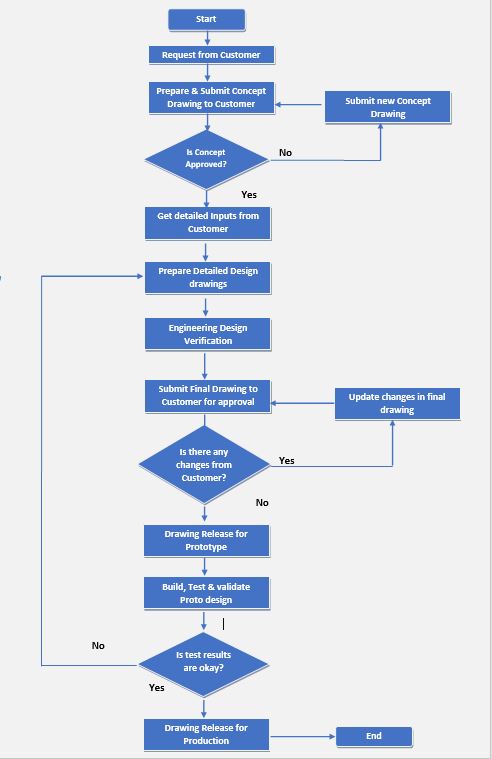
Flow Chart -1

Explanation -


1. As shown in flow chart, firstly customer approaches multiple organizations by providing some requirements of product needed for their vehicle. Let's say, OEM requires tires for their new vehicle, so OEM will approach different organizations having expertise in tire manufacturing.

2. After receiving the request and basic requirements, tire manufacturer starts engineering activities and create concept drawing, CAD model of new tire and submit it to OEM for review.

3. OEM reviews the concept design. If design approved, they provide detailed tire requirements of vehicle to selected tire manufacturing company. If design not approved, tire manufacturing company still has chance to submit another concept design unless and until OEM did not approve any other tire manufacturers concept design.

4. Considering concept design approved scenario we will understand next steps. After receiving detailed requirements tire manufacturer starts working on detail drawing. As product (tire) manufacturer, they are responsible for all engineering design calculation & validation, but OEM also takes part in this.

5. Now, after engineering design validation, tier manufacturer submits final detailed prototype design drawings to OEM for review.

6. If any design changes received, that changes need to accommodate and re-submit the updated Prototype design drawings to OEM. If no design changes received from OEM, tire manufacturers are ready to release Prototype drawings and prototype build is carried out.

7.After prototype build, there are tested in engineering labs as well as actual field environment where final vehicle will be in operation.

8. If results vary from requirements all the activities from detail prototype drawing to engineering lab and field test will be carried out again until the results meet the requirements. If both the engineering lab and actual field results meets the desired vehicle requirements, all prototype drawings are released for production.